

Electric vehicles (EVs) are increasingly common on our roads, bringing new challenges for fire safety professionals. EV fire suppression requires strategies beyond traditional methods, as lithium-ion battery fires burn hotter, release both flammable and toxic gases, and can reignite even after being “extinguished.”
In this blog, we compare two emerging EV fire control tools – fire blankets and encapsulator agents – to determine which offers a smarter, safer, and more effective approach.
Understanding the EV Fire Challenge
EV and hybrid vehicle fires differ significantly from ordinary car fires because of the design and chemistry of their battery systems.
Thermal Runaway & Reignition
A damaged lithium-ion battery pack can undergo thermal runaway, where one overheating cell triggers adjacent cells. Even after flames are knocked down, heat can cause batteries to reignite multiple times. The NTSB found that in three high-speed EV crash fires, the batteries reignited after initial extinguishment. This means first responders must plan for persistent fire risk.
High Heat & Water Demand
Burning EV batteries release enormous heat and high temperatures. Firefighters often need “copious amounts of water” directed at the battery to cool it and halt thermal runaway. EV manufacturers themselves recommend 2,600+ gallons of water (10,000+ liters) per EV fire. Departments are advised to prepare for 3,000 gallons or more of water flow to fully suppress a single EV fire. Such large volumes create logistical challenges and toxic runoff of battery chemicals.
Toxic and Flammable Off-Gases
Li-ion battery fires emit hazardous gases like hydrogen fluoride (HF), carbon monoxide, and flammable hydrocarbons. These gases pose health risks and explosion risks if confined by an EV fire blanket. Firefighters must wear full PPE and SCBA and be mindful of ventilation.
Multi-Class Fire Hazard
EV battery fires encompass multiple fire classes. They involve Class A materials (car interior, plastics), Class C energized electrical components, and even Class D metals (lithium, aluminum) inside certain batteries. Water alone is less effective on combustible metals and may even react violently with them. A versatile agent is needed to tackle this unique mix of hazards.
Traditional Response vs. New Tools
Historically, fire departments have relied on traditional EV firefighting tactics to manage vehicle fires, but these approaches often fall short when dealing with the complexities of EV battery fires:
- Standard Water Streams: Many departments rely on massive water application (often hours of continuous flow) to cool the battery. While water is readily available in some areas, rural fire departments often struggle to access basic resources in the event of an emergency. Using thousands of gallons is not always feasible and creates contaminated runoff that harms the environment.
- Foam and Other Agents: Class B foams (for flammable liquids) have been tried on EV fires, but standard foams are mainly for smothering flames and don’t address the heat of battery cells. Moreover, some firefighting foams contain fluorinated chemicals (PFAS), which are being phased out for health/environmental reasons.
- “Let It Burn” Approach: In some scenarios, responders have opted to secure the area and let an EV burn out, especially if the fire is in a safe location. This can take hours or even days, and is not acceptable in many settings (parking garages, ferries, tunnels) due to potential spread and toxic smoke.
New specialized tools have emerged to improve EV fire incident outcomes:
- EV Fire Blankets – large, fire-resistant blankets that cover a burning vehicle to suffocate flames.
- Encapsulator Agents – innovative firefighting additives (like HCT’s F-500 EA) mixed with water to cool batteries faster and encapsulate burning fuel at the molecular level.
What is an EV Fire Blanket?
EV fire blankets are heavy-duty, heat-resistant blankets designed to be draped over a burning electric vehicle. They are typically made of high-temperature fiberglass, silica, or other fireproof fabrics capable of withstanding extreme heat (short-term up to ~1600–2500 °C). The concept is simple: smother the fire by cutting off its oxygen supply and contain the incident.
How EV Fire Blankets Work:
- Smothering the Flames: By covering the vehicle completely, the blanket starves the fire of oxygen, which can quickly eliminate visible flames. This prevents fire spread to nearby vehicles or structures and reduces the immediate heat output.
- Containing Smoke and Debris: The blanket traps much of the thick smoke and toxic fumes released by the burning battery. It also keeps burning debris (like ejected battery cells) from exploding outward, providing a containment vessel of sorts.
- “Set and Wait” Approach: Once deployed, responders usually leave the blanket in place for hours to ensure the fire is controlled. Departments may carry thermal imaging cameras to monitor the covered vehicle’s temperature and determine when it’s safe to uncover.
Logistics of Fire Blankets:
- Weight and Size: These blankets are large (often ~6m x 8m or bigger) and heavy (weighing 60–90+ lbs / 27–42 kg). It typically takes 2 to 4 firefighters to maneuver and deploy a blanket over an EV. Some models include straps or poles to assist in pulling the blanket over the car.
- Deployment Scenarios: Fire blankets are especially marketed for use in parking garages, tunnels, ferries, or workshops where using massive water flow is impractical and containing smoke is critical. They can also be a quick interim solution while more resources (e.g., water or a wrecker to dunk the car) are en route.
- Reusability and Cost: High-quality EV blankets can be reused multiple times if not too damaged. However, they are expensive and require inspection/cleaning after each use. A heavily contaminated or damaged blanket might need replacement, which is a cost factor.
Limitations and Safety Concerns of Fire Blankets:
- Not a Full Extinguishment: Fire blankets do not actually “put out” a lithium-ion battery fire; they only suppress it. The blanket will eliminate flames and reduce heat, but battery cells may continue to go into thermal runaway under the cover.
- Explosion Hazard: When an EV battery is in runaway, it emits hydrogen, methane, and other flammable vapors. A blanket traps these gases. Fire Safety Research Institute (UL FSRI) and NFPA experiments found that while the blanket stopped visible flames, flammable gas built up under the cover, creating an explosion risk to nearby firefighters. If air is reintroduced (e.g., lifting the blanket too soon), those hot gases can ignite explosively.
- Heat Release and Reignition: Even after hours, once a blanket is removed, the vehicle can flare up again if the battery is still hot. Firefighters must be prepared for possible re-ignition when uncovering and have hose lines or other tools ready.
- Handling and Training: Deploying a blanket on a burning car is physically demanding and potentially risky. Crews have to get in relatively close proximity to a large fire to spread the blanket. Proper training is needed to avoid entanglement, ensure complete coverage, and handle the extremely hot fabric afterward.
- Logistical Challenges: Fire blankets require significant space to deploy correctly, which can be difficult in congested roadways, parking lots, or garages. The idealized scenario, an isolated EV in the early “incipient” fire stage, is rarely what crews encounter. With fire department response times often taking 10–15 minutes, most EV fires are already well developed before a blanket can be applied.
What is an Encapsulator Agent (F-500 EA)?
Encapsulator agents are an advanced class of firefighting additives designed to cool and interrupt fires at the molecular level. Hazard Control Technologies’ F-500 Encapsulator Agent (EA) is a leading example, recognized as a wetting and encapsulating agent by NFPA standards. Unlike foams that form a blanket of bubbles, encapsulator agents mix with water (typically 3% proportion) to create a solution that can be applied with standard fire hoses or trailers.
How Encapsulator Agents Work:
- Encapsulation: F-500 EA® provides exceptional encapsulation, rendering both polar and non-polar fuels non-flammable, significantly reducing the risk of re-ignition and delivering long-term, stable burn-back resistance. Unlike foam, F-500 EA® ensures three-dimensional flowing fuel fire suppression and vapor mitigation.
- Rapid Heat Reduction: F-500 EA® molecules form an outer layer on each water droplet, driving heat internally where micro spherical micelles absorb thermal energy. This engineered advantage provides advanced cooling, halting thermal runaway propagation and cell-to-cell ignition in batteries.
- Free Radical Interruption: F-500 EA® significantly reduces the concentration of harmful hydrocarbons in smoke and soot by interrupting the free radical chain reaction. This ceases the production of a myriad of flammable and toxic off-gases during a lithium-ion battery fire, prioritizing life safety.
- Multi-class Capability: A 3% F-500 EA® solution can be utilized for Class A, B, C, D, and lithium-ion battery fires. In ICE and EV incidents, this means one fluorine-free, biodegradable, and noncorrosive agent can handle the multiple high-hazards seen in modern vehicle manufacturing today.
Logistics and Ease of Use of Encapsulators:
- Equipment: Fire departments can deploy F-500 EA with their existing apparatus. It can be added to standard fire engines via onboard foam proportioning systems or eductors (at 1–3% mix). There is no need for specialized nozzles or a separate delivery system – unlike foams, it doesn’t produce a foam blanket, so any normal hose line works.
- Storage: F-500 concentrate has a long shelf life (15+ years) and is stored in pails, drums, or drums. It’s non-corrosive and biodegradable, which simplifies storage and equipment maintenance (no PFAS to worry about, and it won’t rust pipes or tanks).
- Deployment: Using an encapsulator agent is very similar to a typical hose attack. Firefighters don’t need to physically blanket the fire; instead, they spray the agent solution onto the burning vehicle from a safe distance, as they would water. This means less risk in approach compared to placing a blanket. It also allows continuous cooling during application. One firefighter can operate a hose line if needed, whereas a blanket demands multiple personnel up-close.
- Environmental Impact: Because far less water is used, there is less runoff. Moreover, F-500 EA is fluorine-free (no PFOS/PFOA) and non-toxic to the environment. It also reduces toxic smoke; tests show it can cut hazardous gas emissions by significant percentages. This aligns with a preventative, environmentally responsible approach – a key concern for governments and public safety agencies.
Safety Benefits of Encapsulator Agents:
- Firefighter Safety: By rapidly knocking down the fire and cooling the battery, encapsulator agents reduce the time responders are exposed to extreme heat and toxic smoke. The elimination of flammable vapors means lower risk of unexpected explosions. Firefighters can attack from a distance and do not have to lift a heavy, contaminated blanket on and off the vehicle.
- No Explosion Trap: As noted, F-500 EA actually mitigates flammable gases instead of trapping them. This is a critical safety edge. The agent’s ability to encapsulate and halt off-gassing means the scenario of an oxygen-starved pocket exploding upon re-air exposure isn’t likely.
- Electrical Safety: While water-based, the approach is to cool and extinguish quickly. Many departments have found that using water or water-based agents is necessary despite the high-voltage battery, but as long as proper precautions are taken (spraying from safe distance, appropriate PPE), the benefits outweigh the minimal electrical conductivity issues. Encapsulator agents have been used safely on live battery fires – in fact, NFPA 18A explicitly covers their use on Class C (electrical) fires.
- Multi-use Tool: An encapsulator agent can be used for various incidents – vehicle fires (gasoline or electric), structure fires, fuel spills, and more – making it a versatile addition to a fire department’s arsenal, unlike a single-purpose EV blanket. This can simplify training and inventory (one agent for many scenarios).
Encapsulators vs. Fire Blankets: Key Comparisons
Now that we’ve described each approach, let’s compare fire blankets vs. encapsulator agents across important criteria:
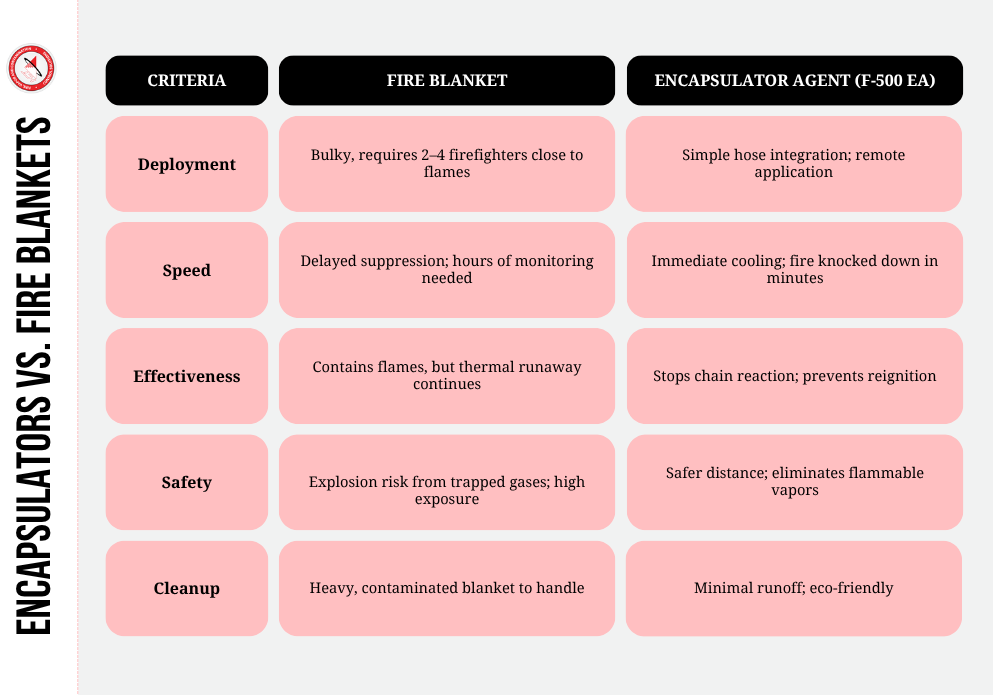
Winner: Encapsulator Agent – Superior for speed, safety, and effectiveness in stopping li-ion battery fires.
A Smarter, Safer Approach to EV Fire Suppression
Electric vehicle fires pose unique challenges, but modern solutions like encapsulator agents allow first responders to handle battery involvement incidents faster and with fewer safety risks. By adopting tools like HCT’s F-500 EA, the fire service can significantly reduce time on scene, prevent hazardous runoff, and eliminate reignition risks, all while protecting crews and the public.
Don’t wait for the next hybrid vehicle fire or EV incident to expose the limitations of old tactics. Equip your department with technology designed for today’s challenges.
Contact Hazard Control Technologies to learn how F-500 EA can strengthen your fire suppression efforts for EVs, hybrids, and other complex incidents.


